Bug Detection & TSCM
Is Your Home or Office Bugged? What Executives Need to Know
The most consequential conversations happen in rooms that feel completely secure. That feeling, however carefully cultivated, is not the same as verified.
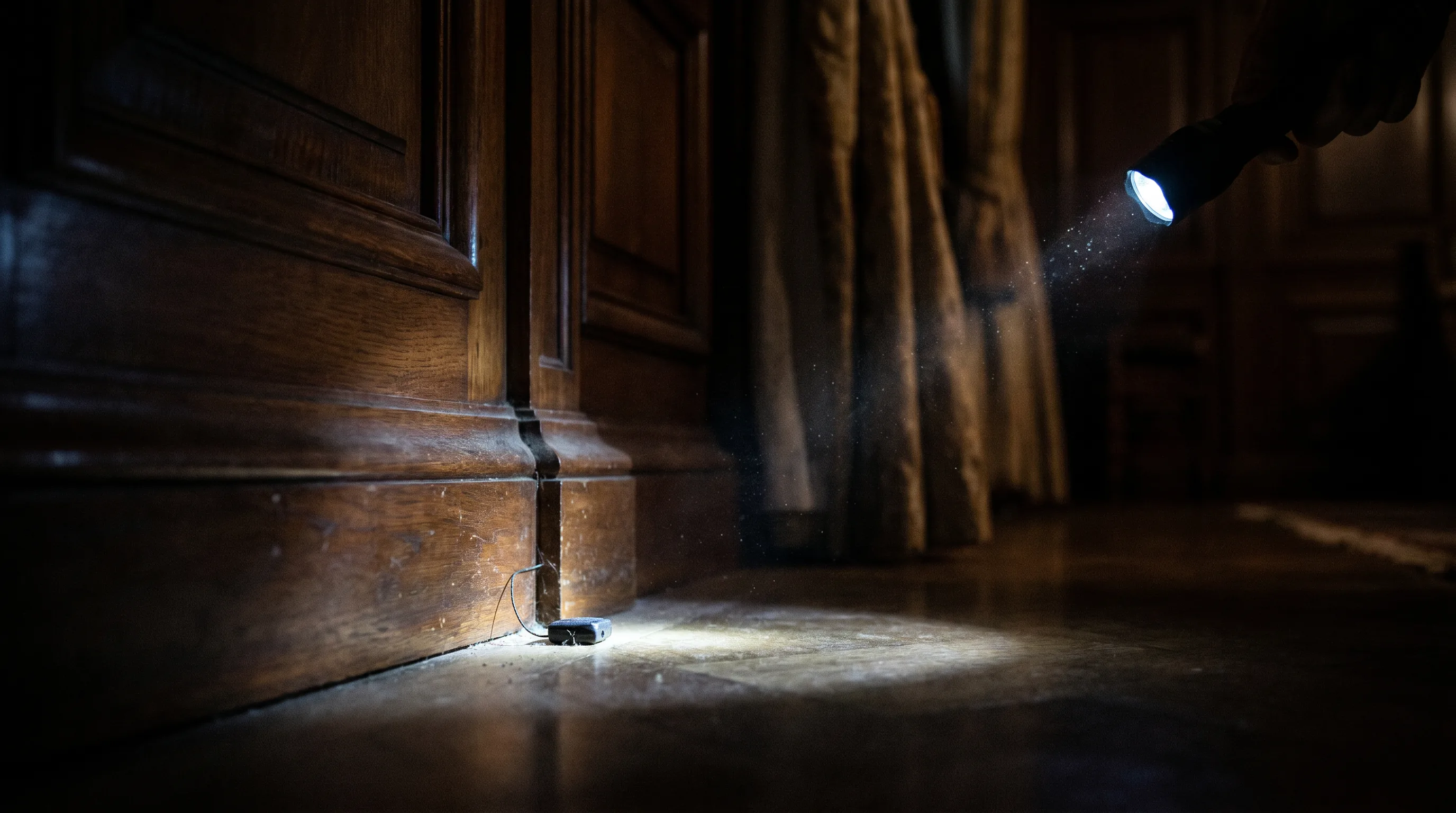
The Room That Should Have Been Private
The meeting had ended the way those meetings do: handshakes, a decanted water, assistants collecting folders. The principals left through a private elevator. The conversation, everyone agreed, had been held in confidence. Then, three weeks later, the other side produced a document that could only have been drawn from that room. Not from a leak. Not from a parallel analysis. From that room, on that afternoon, with those specific words spoken aloud.
The realization does not arrive loudly. It arrives as a pattern of coincidences that stops feeling like coincidence. A negotiation that keeps losing ground at precisely the wrong moments. A proposal that arrives at a competitor's desk before it arrives on your own. A family matter, discussed only at home, that surfaces in litigation. The question that follows is not dramatic. It is methodical. Who had access, and to what.
Why the Threat Has Quietly Expanded
The technology that enables covert audio and video surveillance has, over the past decade, become smaller, cheaper, and vastly easier to conceal. What once required specialized equipment and professional installation can now be purchased in retail packaging, configured over a smartphone, and hidden inside a device no larger than a USB adapter or a power strip. The market for these tools is entirely legal on its face. Their misuse is not.
This shift changes the threat profile for executives and affluent families in two important ways. First, the population of people capable of deploying eavesdropping hardware has grown far beyond the sophisticated adversary. Disgruntled employees, estranged family members, business partners in a deteriorating relationship, domestic staff with divided loyalties: the range of plausible actors is wider than most principals consider. Second, the devices themselves have become harder to detect without professional equipment. A competent sweep is no longer a matter of looking behind picture frames. It requires spectrum analysis, non-linear junction detection, and a systematic examination of every surface, outlet, and installed object in a space.
Further Reading
What Trained Eyes Notice First
There are surface signals that a layperson might notice before calling anyone. Outlets or wall plates that appear freshly disturbed. Smoke detectors or exit signs in unusual positions. Objects on a desk that were not there before a particular visitor. Unexplained wireless networks visible to nearby devices. A phone or laptop that drains its battery unusually fast. None of these observations, individually, constitutes evidence. Taken together, and weighed against the context of who has had physical access to the space, they can constitute reasonable cause to investigate.
What professionals notice goes considerably deeper. Investigators trained in technical surveillance countermeasures, known in the field as TSCM, approach a space the way a physician approaches a patient: with instruments, a methodology, and a baseline of what normal should look like. They are looking not just for devices but for the infrastructure that supports them. A listening device needs power. It needs a transmission path. Those requirements leave traces that trained personnel, using calibrated equipment, can detect even when the device itself is expertly concealed.
The gaps that amateurs miss most reliably are the ones in plain sight. A professionally placed device is rarely behind a loose panel or under a sofa cushion. It is inside the clock that has always been on that credenza. It is integrated into the charging station the facilities team installed last quarter. It is in the conference phone that was replaced after a vendor maintenance call. The access point was legitimate. The device left behind was not.
The Firms Quiet Enough to Trust
A narrow category of firms occupies the space where this kind of work is done with the discipline it requires. They carry proper licensing, operate under regulatory oversight, and can produce documentation that holds up in court. They maintain relationships with legal counsel and understand the distinction between evidence gathered for internal knowledge and evidence gathered for litigation. They do not advertise heavily. They are known, instead, to a small circle of attorneys, family office administrators, and corporate security directors who have needed them before.
Empire Investigation LLC operates within that world. Licensed in Pennsylvania for over four decades, with technical capabilities certified through Ross Engineering, one of the recognized standards bodies in the TSCM field, the firm brings an investigative discipline to electronic sweeps that separates professional practice from the walk-in detector kits available online. Its work has appeared in national media contexts and has been used to support matters before courts. That record is not a marketing claim. It is a description of the kind of environment in which this work must reliably perform.
What a Professional Sweep Actually Involves
A credible TSCM engagement begins before anyone enters a room. The investigator needs to understand the physical history of the space: who has had access, when, and under what circumstances. Contractors, cleaning crews, delivery personnel, former employees, visiting counterparties from an adversarial negotiation. That access history shapes where scrutiny is concentrated.
The physical examination itself covers the radio frequency spectrum, infrared transmission paths, hardwired audio circuits, and the physical integrity of every installed object in the space. Modern TSCM equipment can identify active transmissions, but it can also detect devices that are dormant or on scheduled activation cycles, which is a design feature of more sophisticated hardware. Cellular-connected devices, in particular, may never transmit locally and cannot be detected by radio frequency scanning alone. Physical inspection, conducted systematically, remains irreplaceable.
Documentation throughout the process is non-negotiable. What was examined, how, and with what result. If a device is found, chain of custody procedures govern how it is handled from the moment of discovery. That chain of custody is what transforms a finding into usable evidence. It is the difference between knowing what happened and being able to prove it to a court, a mediator, or a board.
The Honest Counterpoint
Not every suspicion has a device behind it. A business negotiation can go badly for reasons that have nothing to do with surveillance. A competitor can arrive at the same analysis independently. Information can travel through channels that have nothing to do with your conference room. Coincidence, while unsatisfying, exists.
A responsible investigation accounts for this. The goal of a TSCM sweep is not to confirm a fear. It is to establish, with professional rigor, whether a space is clean or compromised. A negative result is valuable. It rules out one category of exposure and returns attention to other possible explanations. Investigators who approach the work without that neutrality, who are effectively looking for something to find, are not serving their clients. They are serving a narrative. The distinction matters, and it is worth asking about directly when engaging any firm for this work.
What to Do Before the Investigator Arrives
If you have a reasonable basis to believe a space has been compromised, a few principles govern behavior in the interim. First, do not discuss the suspicion itself in the space you believe is monitored. Move sensitive conversations to a neutral environment with no electronic devices present. This is not overcaution. It is the same instinct that leads attorneys to conduct privileged conversations away from a client's office when the situation warrants it.
Second, do not disturb objects, outlets, or installed equipment. A device handled by multiple people before a professional can examine it loses forensic value. The chain of custody begins at the moment of discovery, not at the moment of collection. Touching a suspected device changes what can be learned from it.
Third, document access. Reconstruct, as accurately as possible, who has been in the space and when, over a meaningful period. That list becomes one of the most important documents in the matter. It gives the investigator a framework and, if a device is found, a population of persons of interest to examine further.
Finally, engage counsel early. In matters where surveillance evidence may become relevant to litigation, divorce proceedings, or employment disputes, the manner in which an investigation is structured can affect whether its findings are admissible and whether the investigation itself creates any legal exposure. The investigator and the attorney should be working in the same direction from the beginning.
The Standard Worth Keeping
There is a version of this subject that tips into anxiety, into the kind of permanent vigilance that treats every room as a threat and every visitor as a suspect. That version is not useful. It erodes judgment and, ultimately, replaces one vulnerability with another.
The useful version is simpler. A serious principal, managing serious affairs, should understand the landscape of technical surveillance with the same clarity applied to financial or legal risk. Not because threats are everywhere. Because when a threat is present, the response to it, the quality of the sweep, the rigor of the documentation, the care with which evidence is preserved, determines whether the situation can be resolved or whether it simply continues. The point is not suspicion. The point is clarity.
Confidential consultations to assess whether a sweep is warranted are available through Empire Investigation at areyoususpicious.com.
Questions, Answered
How do I know if my home or office has been bugged?
Common early indicators include objects that appear recently moved or replaced, unfamiliar wireless networks detected near the space, and a pattern of sensitive information reaching people who should not have it. These signs alone are not proof, but they are reasonable cause to request a professional TSCM sweep. A trained investigator uses spectrum analysis and physical inspection to determine whether a space is clean or compromised.
What does a professional bug sweep involve?
A professional TSCM sweep covers radio frequency transmission, infrared paths, hardwired audio circuits, and the physical inspection of every installed object, outlet, and surface in the space. Investigators also review access history to understand who may have had the opportunity to place a device. If a device is found, it is handled under chain of custody procedures so the finding can support legal action if needed.
Is it legal to sweep my own home or office for listening devices?
In general, yes. A property owner or authorized occupant has the right to examine their own space for unauthorized surveillance equipment. The legal complexity arises when a device is found and the response involves further investigation of the person who placed it. Engaging a licensed private investigator and notifying legal counsel before any device is removed preserves your options and protects the evidentiary value of the finding.
How often should executives or high-net-worth families have a bug sweep done?
The available guidance in the TSCM field suggests that periodic sweeps, conducted after any significant change in personnel, following contractor work in a sensitive space, or before and after high-stakes negotiations, represent a reasonable baseline. Reactive sweeps prompted by a specific suspicion are common, but proactive sweeps conducted on a schedule reduce the window of potential exposure. The appropriate frequency depends on the nature of the risks involved.
What should I do if I find a listening device before calling an investigator?
Do not touch, move, or photograph the device in a way that disturbs it. Leave the space and avoid discussing the discovery in any room that may also be monitored. Contact a licensed TSCM professional and your legal counsel as quickly as possible. The chain of custody for the device begins at the moment of discovery, and how it is handled in the first hours significantly affects what can be learned from it and whether it can support legal proceedings.
Keep Reading
More from the Dispatch

TSCM
The Compromised Room: Boardroom Bug Sweeps and Executive Privacy
The most consequential conversations in any organization happen in a single room. That room is also, by design, the easiest one to compromise.
Read Article
TSCM
The Locker Room Nobody Checked: Athletic Facility Privacy Assessments
The most vulnerable spaces in a school or university rarely appear on a standard security audit. Athletic changing rooms, training suites, and field houses occupy a category of exposure that generic reviews consistently miss, and the consequences of that oversight have a way of arriving without warning.
Read Article